


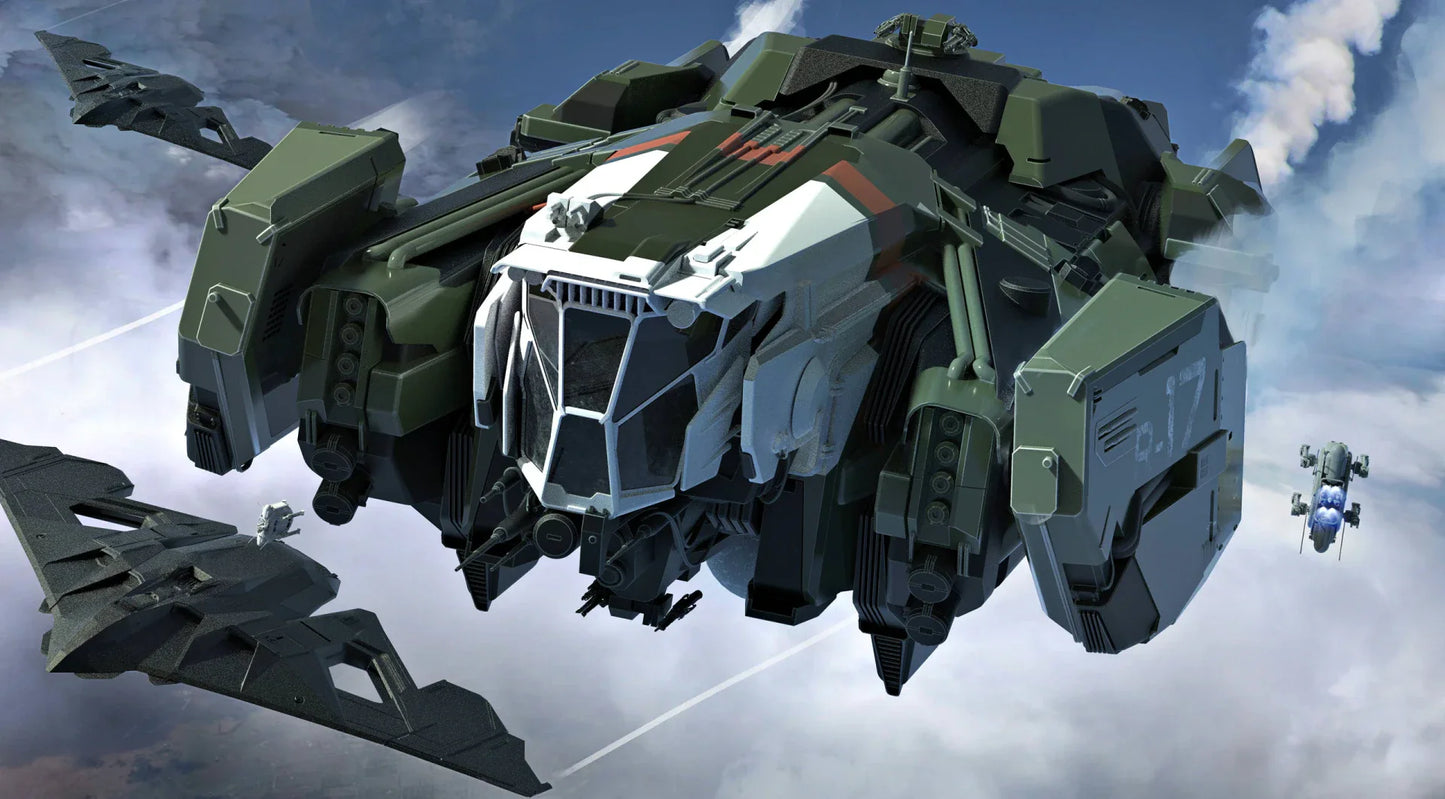
From Aegis Dynamics | Max Crew3 | In-Game Status In Development
Vulcan - Standalone Ship
Consultez nos délais de livraison.
aUEC Star Citizen : livraison en 3 à 5 minutes.
Vaisseaux Star Citizen : livraison généralement sous 20 à 30 minutes, 12 heures maximum.
CCU Star Citizen : livraison généralement sous 20 à 30 minutes, 12 heures maximum.
Paints Star Citizen : livraison généralement sous 5 minutes, 12 heures maximum.
Items Star Citizen : livraison généralement sous 5 minutes, 12 heures maximum.
Comment claim vos Ships, CCU, Paints et Items Star Citizen
Pour accepter cet item, vous devez avoir un compte sur robertsspaceindustries.com. L’accès à Star Citizen nécessite un Game Package.
Toutes les commandes seront envoyées à l’adresse e-mail utilisée lors du paiement. Vous recevrez un e-mail intitulé « Someone sent you a gift from Roberts Space Industries », envoyé par no-reply@robertsspaceindustries.com.
Ouvrez l’e-mail, puis cliquez sur le bouton bleu « Claim Gift » pour claim votre commande.
Si vous souhaitez recevoir votre commande sur un autre compte RSI que celui lié à l’e-mail fourni, connectez-vous simplement au bon compte RSI dans un autre onglet avant de claim l’item. Pensez à rafraîchir la page RSI pour vérifier que vous êtes bien connecté au bon compte.
Si vous achetez cet item comme cadeau, faites un clic droit sur le bouton bleu « Claim Gift », puis copiez l’adresse du lien. Assurez-vous d’être déconnecté de votre propre compte RSI afin de ne pas claim l’item par erreur.
Instructions de sécurité importantes
ATTENTION : tous les Ships et Items ne peuvent être gift qu’une seule fois.
Une fois claim, l’item — Ship, CCU, Paint, Armor, Weapon, etc. — est définitivement lié au compte qui l’a accepté.
Veuillez donc vérifier avec attention que vous êtes connecté au bon compte RSI avant de claim votre Gift Email.
Assurez-vous d’être connecté, dans le même navigateur, au compte RSI sur lequel vous souhaitez recevoir l’item avant de cliquer sur « Claim Gift ».
Nous ne sommes pas responsables si vous claim l’item sur le mauvais compte RSI.
Comment apply un CCU (Ship Upgrade)
Si vous avez acheté un Cross Chassis Upgrade (CCU) pour upgrade un Ship vers un autre, voici les étapes à suivre :
1. Claim l’item
Suivez les étapes de livraison ci-dessus pour ajouter le CCU à votre RSI Hangar.
2. Trouver le CCU dans le Hangar
Allez dans la section « My Hangar » sur le site RSI.
3. Apply Upgrade
Cliquez sur la flèche à côté de votre CCU pour ouvrir les détails, puis cliquez sur « Apply Upgrade ».
Choisissez le « Source Ship » que vous souhaitez upgrade, puis entrez votre mot de passe RSI pour terminer le processus.
Note importante :
L’assurance, comme la LTI, ainsi que les autres bonus du Ship de base seront conservés et transférés vers le nouveau Ship.
Un upgrade d’un Ship moins cher vers un Ship plus cher peut nécessiter plusieurs CCU.
Par exemple, si vous achetez un upgrade de Merchantman vers Polaris, nous vous enverrons deux CCU : Merchantman vers Hammerhead, puis Hammerhead vers Polaris.
Plus l’écart de prix est grand, plus vous pouvez recevoir de CCU à apply.
Achetez en toute confiance : protection client
Protection d’achat
Lorsque vous passez commande sur notre site, nous vous garantissons que vous recevrez l’item correct, conforme à sa description.
Si nous ne pouvons pas livrer l’item commandé, nous vous proposerons un remplacement ou un remboursement intégral, selon votre préférence.
Protection après-vente
Tous les items proposés sur notre site proviennent de notre propre stock et sont couverts par notre protection après-vente.
Si un problème survient pendant la livraison, ou dans un délai allant jusqu’à 6 mois après la livraison, nous effectuerons une vérification.
Si le problème est confirmé comme étant de notre responsabilité, nous vous proposerons un remplacement ou un remboursement.
Selon la situation, cela peut prendre la forme d’un remplacement complet, d’un remboursement intégral ou d’un upgrade vers un meilleur item si le remplacement exact n’est pas disponible.
Assistance client 24h/24 et 7j/7
Bénéficiez d’un support en ligne 24h/24 et 7j/7.
Questions, assistance ou besoin d’une solution rapide ? Notre équipe est toujours disponible pour vous aider. À tout moment, nous sommes à un clic de vous.
Rejoignez notre Discord dès maintenant et découvrez la différence LTI Hangar !
En stock · Livraison via RSI Gift · Livraison en moyenne sous 20 min


Contact our Discord live support; we are online 24/7.

Pourquoi les joueurs choisissent LTI Hangar
Livraison rapide de Ships, vrai support client, et processus de RSI Gift clair — pensé pour les joueurs Star Citizen qui veulent une expérience d’achat plus simple et plus fluide.
Livraison moyenne en 20 à 30 min
Support Discord 24/7
Équipe de gamers avec plus de 10 ans d’expérience
Achat sécurisé · Stock propre · Aucun vendeur tiers
Support après-vente fiable
Suivi de commande en temps réel
FAQ — Questions fréquentes
Combien de temps prend généralement la livraison ?
Les commandes de Ships, CCU, Paints et Items Star Citizen sont généralement livrées sous 20 à 30 minutes.
Dans de rares cas, la livraison peut prendre jusqu’à 12 heures en raison du volume de commandes, des limites de gifting RSI, du statut du compte ou d’une vérification manuelle nécessaire.
Dans la plupart des cas, nous ne laissons pas les livraisons de Ships dépasser 12 heures, sauf en cas de problème exceptionnel, comme une limitation du système RSI, une restriction de compte ou une vérification client requise.
Ma commande de Ship est-elle protégée ?
Oui. La sécurité et la fiabilité sont nos priorités absolues.
Tous les Ships vendus par LTI Hangar viennent de notre propre stock. Aucun vendeur externe ni fournisseur tiers inconnu n’intervient dans la commande.
Chaque commande de Ship est traitée avec un suivi clair de la livraison, afin que le processus puisse être vérifié et retracé si notre support doit intervenir.
Nous offrons également une protection après-vente de 6 mois pour les problèmes éligibles liés à la livraison.
Grâce à notre propre stock, à une livraison traçable et à notre protection après-vente, l’achat est plus sûr que sur de nombreuses marketplaces tierces. C’est l’une des raisons pour lesquelles de nombreux joueurs choisissent LTI Hangar pour acheter leurs Ships Star Citizen.
Qu’est-ce que la protection après-vente de 6 mois ?Pourquoi les autres marketplaces ne peuvent-elles pas proposer cela ?
Dans le cas extrêmement rare où un problème survient avec un item pendant la livraison, ou jusqu’à 6 mois après la livraison, nous mènerons une vérification.
Si le problème est confirmé comme étant de notre responsabilité, nous vous proposerons soit un remplacement, soit un remboursement.
Pour nous aider à examiner le cas avec précision, il pourra vous être demandé de nous fournir des preuves pertinentes, comme des screenshots de votre RSI Hangar, les détails de commande ou les logs du RSI Hangar.
Le RSI Hangar Log permet de suivre l’état et l’historique de chaque Ship, notamment si l’item a été claim, échangé, melt, transféré ou modifié d’une autre manière après la livraison.
Nous examinerons les preuves fournies afin de déterminer la cause du problème.
Ce niveau de protection n’est pas courant sur de nombreuses marketplaces tierces, car elles dépendent souvent de vendeurs externes ou de sources de stock mélangées.
Chez LTI Hangar, tous les Ships proviennent de notre propre stock, et chaque commande dispose de records de livraison clairs. Cela nous permet d’offrir un support plus sûr, plus fiable et plus transparent.
Puis-je demander un remboursement après avoir claim le Ship, CCU, Paint ou Item ?
Une fois le RSI Gift claim, le Ship, CCU, Paint ou Item est lié au compte RSI qui l’a reçu.
En raison des limites du système de gifting de Star Citizen, un item déjà claim ne peut normalement pas être gift à nouveau, retourné, annulé ou relivré. Pour cette raison, les items déjà claim ne sont généralement pas éligibles à une annulation ou à un remboursement.
Une correction, un remplacement ou un remboursement ne peut être proposé que si nous confirmons que le problème vient de notre côté, par exemple si un mauvais item a été envoyé, s’il y a eu une erreur de livraison de commande, ou un autre problème de livraison vérifié causé par nous.
Avant de claim le RSI Gift, veuillez vous assurer que vous êtes connecté au bon compte RSI. Une fois le gift claim sur le mauvais compte, il ne peut normalement pas être transféré vers un autre compte.
Que se passe-t-il si le mauvais Ship, CCU, Paint ou Item est livré ?
Si nous confirmons qu’un mauvais item a été livré à cause d’une erreur de notre côté, nous examinerons le cas et proposerons une correction, un remplacement ou un remboursement lorsque cela est applicable.
Veuillez nous contacter avec votre numéro de commande, l’e-mail utilisé lors du paiement, ainsi que des screenshots clairs de votre RSI Hangar.
Pourquoi les noms des Ships Star Citizen que j’ai reçus sont-ils différents ?
Un Standalone CCU’ed est un vaisseau ou un véhicule complet. Ce n’est pas une amélioration à appliquer !
CCU’ed signifie simplement que le vaisseau ou véhicule a été obtenu en améliorant un modèle plus petit vers celui que vous achetez.
Veuillez également noter que, dans l’e-mail cadeau, seul le vaisseau utilisé comme base de l’upgrade sera indiqué. Pas d’inquiétude : le vaisseau qui apparaîtra réellement dans votre hangar sera bien celui que vous avez commandé.
Par exemple, voici à quoi ressemble un Polaris CCU’ed dans le hangar sur le site RSI.
COMMENT ÇA FONCTIONNE
Simple, rapide et sécurisé : découvrez comment ça fonctionne !

EST-CE VRAIMENT SÉCURISÉ ?
La sécurité est notre priorité n°1.
Contrairement à d’autres sites, nous vendons uniquement notre propre stock. Aucun vendeur externe n’est autorisé sur notre plateforme.
Cela garantit un achat plus sûr, une vraie tranquillité d’esprit, ainsi que des livraisons ultra-rapides.

COMMENT FONCTIONNE LA LIVRAISON ?
L’item sera livré via le système de RSI Gift.
Après avoir passé commande, nous enverrons l’item à l’adresse e-mail que vous avez indiquée au checkout.
Une fois le Gift Email reçu, ouvrez-le simplement, puis cliquez sur « Claim ». L’item sera alors ajouté au compte RSI sur lequel vous êtes connecté.

PROTECTION APRÈS-VENTE
Tous les items que nous vendons proviennent de notre propre stock et sont couverts par notre politique de protection après-vente.
Si un problème survient avec un item pendant la livraison, ou jusqu’à 6 mois après la livraison, nous mènerons une vérification.
Si le problème est confirmé comme étant de notre responsabilité, nous proposerons soit un remplacement, soit un remboursement.

CONTACTEZ-NOUS
Star Citizen est un univers vaste et complexe ! Si vous avez des questions, notre équipe est toujours là pour vous aider.
Nous sommes disponibles 24h/24 pour vous accompagner. En plus, notre Discord propose des codes promo supplémentaires, des giveaways et les dernières annonces.
Aegis Vulcan Standalone Ship Future Gameplay Guide
The Aegis Vulcan is a concept-stage support ship built for Star Citizen players who want future repair, refuel, rearm, recovery support, and small-team fleet logistics. It is not a cargo hauler, medical ship, salvage ship, combat fighter, refinery ship, or capital-class service platform. The Vulcan is best understood as a future frontline support ship: the ship you bring when other pilots need help staying operational.
Official RSI material presents the Vulcan around the three support roles: Refuel, Repair, Rearm. The concept includes BARD drones, support stations, external fuel tanks, a rear cargo hold for supplies, modest crew living space, and enough room for three crew members. Current reference data still lists the Vulcan as In Concept, with 1–3 crew, 12 SCU cargo, and medium repair / medium refuel roles.
The safest product-page positioning is simple:
The Vulcan is the Aegis ship you choose for future field support and fleet logistics — not for current flyable gameplay, solo cargo profit, or direct combat power.
Build Your Aegis Support Fleet with the Vulcan
The Vulcan is a long-term support purchase for players who want to help other ships stay in the fight or return safely from damaged, low-fuel, or under-supplied situations. If you are looking to acquire this Aegis support ship, you can explore our available options in the Star Citizen Ships and Vehicles Collection.
Aegis Vulcan Key Specifications
| Specification | Aegis Vulcan | Gameplay Meaning |
|---|---|---|
| Manufacturer | Aegis Dynamics | Military-linked manufacturer with clear fleet and support history. |
| Role | Medium Repair / Medium Refuel / Rearm Support | Built around keeping other ships operational, not replacing dedicated combat or cargo ships. |
| Status | In Concept / future support-gameplay reference | Not currently Flight Ready; buyers use the current loaner until the final Vulcan becomes playable. |
| Current Loaner | Starfarer temporary loaner reference | Provides current refueling-style gameplay access, but the Starfarer is temporary and should not be treated as a permanent included ship. |
| Crew | 1–3 current reference / 3 crew concept focus | Best used by a small support crew, especially when drones and stations matter. |
| Cargo Capacity | 12 SCU support-supply reference | For parts, supplies, ammunition, and support materials, not cargo-profit hauling. |
| Dimensions | 38.5m length / 16.5m width / 10m height | Medium support-ship footprint, not a capital service ship. |
| Support Drones | 4 BARD drones concept reference | Core future support system for repair, refuel, and rearm tasks, but final drone behavior and support workflow may change before release. |
| Support Stations | 2 support stations in cockpit | Drone operators control drones from onboard stations, not mobiGlas. |
| Fuel Support | External fuel tanks for hydrogen and quantum fuel concept | Supports the refueling side of the Vulcan’s role. |
| Core Gameplay | Repair, refuel, rearm, rescue support, convoy support, fleet logistics | Best for players who enjoy helping other ships, not chasing solo DPS. |
Note: The Vulcan is still concept-stage. Drone behavior, repair systems, fuel systems, ammunition restocking, cargo requirements, ship balance, and final support gameplay may change before release.
What Makes the Vulcan Valuable?
The Vulcan is useful because it fills a smaller, more flexible support role than huge service ships. It is not trying to be a Starfarer, Crucible, Kraken, or capital carrier. It is designed for the player who want to show up near the fight, near a convoy, near a mining team, or near a stranded ship and provide practical help.
RSI describes the Vulcan as a support ship built around the three R’s: refuel, repair, and rearm. The concept page also says the ship carries BARD drones, has drone launchers on both sides, uses external fuel tanks, and has a rear cargo hold for supplies.
The Vulcan is not the ship you buy to win the fight directly. It is the ship you buy to keep your fleet operating when fuel, damage, or ammunition becomes a problem.
That is the core buyer message. The Vulcan is for logistics-minded players, rescue crews, org support teams, and people who like being useful when other ships are damaged, empty, or out of ammo.
Field Support Gameplay Role
The Vulcan’s main role is future field support. It is designed to help other ships recover without returning to a station every time they need fuel, repairs, or restock support.
In practical future gameplay, the Vulcan fits several roles:
| Gameplay Use | Why the Vulcan Fits |
|---|---|
| Refueling support | External fuel tanks are part of the concept, including support for hydrogen and quantum fuel. |
| Repair support | BARD drones are intended to perform repair work without forcing the crew into a spacewalk. |
| Rearm support | The Vulcan’s concept includes rearming other ships when needed most. |
| Ground vehicle support | RSI’s Q&A says the Vulcan can repair, rearm, and refuel ground vehicles as well as ships. |
| Convoy support | The Vulcan makes sense behind cargo ships, patrol groups, fighters, or industrial crews. |
| Rescue-response gameplay | Useful for pilots stranded with low fuel, damaged thrusters, or missing supplies. |
| Small-org logistics | Easier to imagine for smaller crews than larger support platforms. |
The Vulcan should be described as a future support ship, not a current money-making profession ship.
Repair, Refuel, Rearm: The Three Core Roles
The Vulcan’s cleanest selling point is simple: one ship, three support functions.
| Support Role | Player-Facing Meaning |
|---|---|
| Repair | Help damaged ships recover enough to continue or return safely. |
| Refuel | Top off ships running low on hydrogen or quantum fuel. |
| Rearm | Bring ammo and ordnance support to ships away from station services. |
RSI’s concept page directly frames the Vulcan around these three roles and explains that it uses BARD drones and support stations to oversee repairs, external tanks for refueling, and supply support for rearming.
The Vulcan is for players who want a useful job even when they are not the main fighter, hauler, miner, or explorer.
That makes it different from ships bought only for personal income or combat stats.
BARD Drones and Support Stations
The Vulcan’s support gameplay is built around drones. RSI says each Vulcan comes standard with four BARD drones, and current reference material says two drones may be active at the same time while the other two remain stored for replacement or alternate tasks.
RSI’s Q&A explains that drone operators sit at the Vulcan’s support stations and fly the drones from a first-person view through the station screens. The same Q&A says operating the Vulcan’s drones through mobiGlas was not planned.
The Vulcan is not just a ship with a service button. Its future gameplay is expected to involve crew members actively operating drones from support stations.
This is important because it makes the Vulcan more interesting for players who want a real crew job.
Supplies, Components, and Cargo
The Vulcan has a small rear cargo hold, and current reference data lists 12 SCU cargo. RSI’s concept page describes that hold as carrying cargo or supplies to help ships in distress.
RSI’s Q&A also says players may need a good stockpile of ship components if they want to repair a wide range of ships, though players could also carry more generic items for faster response work.
The Vulcan’s 12 SCU is not for cargo trading. It is for support supplies, components, ammunition, and repair materials.
Cargo-profit buyers should look at Taurus, Starlancer MAX, C2, Caterpillar, Hull C, Railen, or other haulers instead.
Ground Vehicle Support
One of the Vulcan’s useful future angles is that it is not limited to spacecraft support. RSI’s Q&A says the Vulcan can repair, rearm, and refuel ground vehicles because ground vehicles conform to the same item mechanics as ships on a smaller scale.
The Vulcan could become useful for surface operations because it supports vehicles as well as ships.
That makes it relevant for orgs running bunkers, outposts, mining sites, convoys, vehicle patrols, or ground-combat events.
Defense and Survival Expectations
The Vulcan can defend itself, but it should not be sold as a combat ship. Current reference material lists pilot weapons and remote turrets, while RSI’s concept page describes the ship as balancing firepower and protection for a support role.
Whitley’s Guide is also useful for expectation-setting: in lore, the UEE learned that Vulcans needed escort protection, and the military adapted by assigning support groups and escort fighters around them.
The Vulcan has defensive tools, but smart Vulcan pilots should think like support crews, not frontline brawlers.
If the buyer wants direct combat, a fighter, gunship, or corvette is a better fit.
Crew Gameplay and Real Player Use
The Vulcan is a small crew support ship. Current reference data lists 1–3 crew, while the concept material describes room for three crew members and two support stations.
A practical Vulcan crew may include:
| Crew Role | Purpose |
|---|---|
| Pilot / Captain | Positions the ship safely, manages approach, retreat, and customer coordination. |
| Support Operator 1 | Controls drones for repair, refuel, or rearm tasks. |
| Support Operator 2 | Runs a second active drone or helps manage support workflow. |
| Escort Pilot | Protects the Vulcan while it services damaged or low-fuel ships. |
| Logistics Planner | Decides what components, fuel, ammo, and supplies to carry before leaving port. |
The Vulcan feels most useful when the pilot brings the ship to the right place and the support crew keeps other ships moving.
A practical Vulcan operation should feel like a small service crew answering a support call, not a normal combat or cargo run. Before leaving port, the crew needs to decide what parts, ammunition, fuel, and repair materials to carry. The pilot has to park the ship safely near the damaged or low-fuel target, while support operators manage drones and service workflow from the stations. In dangerous areas, escorts or friendly ships may be needed because the Vulcan’s value comes from keeping others operational, not winning fights by itself. Right now, ownership is mostly about the Starfarer loaner and long-term planning; when the Vulcan eventually arrives, its usefulness will depend on real demand for repair, refuel, rearm, and rescue support.
Solo Gameplay Expectations
The Vulcan can likely be owned and moved by one player, but it is not a solo-efficiency ship. The concept is built around support stations, drones, supplies, and other players needing service.
Solo ownership is possible, but the Vulcan makes the most sense when you have people to support.
Solo players who want daily convenience should compare smaller multi-role ships. Solo players who enjoy rescue, service calls, and org logistics may still find the Vulcan attractive as a long-term support choice.
Current Loaner: Starfarer
The Vulcan is not Flight Ready, so owners currently use a loaner. RSI’s loaner matrix, updated for 4.8.2-live, lists Vulcan → Starfarer. RSI also explains that loaners are temporary, not permanent fleet additions, and are replaced once the purchased ship becomes Flight Ready.
The Starfarer loaner gives Vulcan owners current refueling-style gameplay access, but it is not the Vulcan’s final size, role, or operating feel.
This matters because the Starfarer is much larger and more specialized around fuel, while the Vulcan’s concept is smaller and more multi-role support-focused.
Direct Vehicle Comparisons
Vulcan vs Starfarer
The Starfarer is the current loaner and the natural comparison, but the two ships should not be treated as the same.
| Ship | Best For | Main Difference |
|---|---|---|
| Vulcan | Future repair, refuel, and rearm support | Smaller, more flexible, and drone-based in concept. |
| Starfarer | Fuel transport and refueling | Larger dedicated tanker identity and current loaner for Vulcan owners. |
Choose the Starfarer if you want a dedicated tanker-style ship. Choose the Vulcan if you want a future smaller support ship that can repair, refuel, and rearm.
Vulcan vs Crucible
The Crucible is the larger repair-focused ship. The Vulcan is the smaller field support ship.
| Ship | Best For | Main Difference |
|---|---|---|
| Vulcan | Smaller field repair, refuel, and rearm support | More flexible support identity and smaller crew footprint. |
| Anvil Crucible | Larger repair operations | Better if the buyer wants repair as the main profession and larger workshop-style gameplay. |
Choose the Crucible if repair is your main career. Choose the Vulcan if you want repair plus refuel and rearm support in a smaller package.
Vulcan vs Apollo, SRV & Expanse
| Ship | Best For | Main Difference |
|---|---|---|
| Vulcan | Repairing, refueling, and rearming ships and vehicles | Keeps machines operational around repair, fuel, and ammo support. |
| RSI Apollo | Medical rescue and patient treatment | Keeps players alive rather than mechanical support for ships. |
| ARGO SRV | Tractor towing and recovery | Moves disabled ships or objects rather than servicing them. |
| MISC Expanse | Refining mined material | Supports mining operations through refining workflow rather than field service. |
Choose the Apollo if the problem is injured people. Choose the Vulcan if the problem is damaged, empty, or under-supplied vehicles and ships. Choose the SRV if you need to move the ship. Choose the Vulcan if you need to service the ship. Choose the Expanse for mining logistics. Choose the Vulcan for fleet service logistics.
Vulcan vs Liberator & Kraken
| Ship | Best For | Main Difference |
|---|---|---|
| Vulcan | Support services for ships and vehicles | Repairs, refuels, and rearms in concept for small-team field support. |
| Anvil Liberator | Moving ships and vehicles | Transports assets on pads rather than servicing them. |
| Drake Kraken | Carrier operations and larger fleet support | Much larger, more expensive, and more organization-dependent platform. |
Choose the Liberator if you need to move vehicles and ships. Choose the Vulcan if you need to keep them supplied and repaired. Choose the Kraken if you want a carrier platform. Choose the Vulcan if you want a smaller support ship for service calls and fleet logistics.
Vulcan vs Vulcan CTR / Hazard Yellow Paints
RSI’s concept material says the Vulcan was shown in three liveries representing its functions: base military green for rearm, hazard yellow for repair, and CTR blue for refuel.
| Version / Paint Identity | Best For | Main Difference |
|---|---|---|
| Base Vulcan | Standard Aegis support identity | Military green support-ship look. |
| Hazard Yellow | Repair-themed visual identity | Yellow repair-service styling. |
| CTR Blue | Refuel-themed visual identity | Civilian fuel-service / CTR-style presentation. |
The Vulcan’s paint identity changes the presentation, not the core concept role: repair, refuel, and rearm support.
Cargo, Combat, and Profit Expectations
The Vulcan should not be sold as a guaranteed profit ship. Its future value depends on whether repair, fuel, ammunition, components, service beacons, player contracts, org logistics, and support gameplay are rewarding and practical when the ship releases.
If the buyer wants:
- cargo profit, choose a hauler.
- medical rescue, choose a medical ship.
- towing, choose an SRV.
- fuel scale, compare Starfarer.
- repair as the main career, compare Crucible.
- small-team field service, choose Vulcan.
The Vulcan has useful long-term potential, but its real value depends on future support gameplay, supply costs, customer demand, and crew coordination.
Explore Vulcan Upgrade Paths
If you prefer to build toward the Vulcan from another ship, you can view our Star Citizen Vulcan CCU Upgrades and plan a more flexible Aegis support, repair, refuel, or rearm upgrade path over time.
For the Vulcan specifically, buyers should check the exact listing carefully because it is still a concept-stage, time-limited support ship. Current gameplay access is through the Starfarer loaner rather than the final released Vulcan.
Vulcan vs Other Star Citizen Support Ships
| Ship Fleet Option | Primary Core Role | Compared with Vulcan |
|---|---|---|
| Starfarer | Refueling / Fuel Transport | Current Vulcan loaner; larger tanker identity. |
| Crucible | Repair | More repair-focused and larger; Vulcan is broader support. |
| Apollo Medivac / Triage | Medical Rescue | Medical support for players, not mechanical support for ships. |
| ARGO SRV | Towing / Recovery | Moves ships and objects; Vulcan services them. |
| MISC Expanse | Refining | Mining-logistics ship; Vulcan is service logistics. |
| Liberator | Ship / Vehicle Transport | Moves vehicles and small craft; Vulcan supports and maintains them. |
| Kraken | Carrier / Fleet Support | Much larger platform; Vulcan is smaller field support. |
| Polaris | Military Corvette | Combat ship with support facilities, not a dedicated field-service craft. |
Vulcan vs Starfarer
The Starfarer is better for players who want current refueling-style gameplay, larger fuel capacity, and tanker identity. The Vulcan is better for players who want a future smaller support ship built around repair, refuel, and rearm services. Choose the Starfarer for dedicated tanker gameplay. Choose the Vulcan for future multi-role field support.
Vulcan vs Crucible
The Crucible is better for players who want a larger repair-first platform and deeper repair-career identity. The Vulcan is better for players who want a smaller support ship that can repair, refuel, and rearm in one package. Choose the Crucible for dedicated repair. Choose the Vulcan for flexible field service.
Vulcan vs Apollo
The Apollo is better for players who want medical rescue, patient treatment, and healthcare gameplay. The Vulcan is better for players who want to service ships and vehicles through repair, refuel, and rearm support. Choose the Apollo if the problem is injured players. Choose the Vulcan if the problem is damaged or under-supplied machines.
Vulcan vs SRV
The SRV is better for players who want towing, recovery, and moving disabled ships or objects. The Vulcan is better for players who want to restore ships and vehicles through repair, fuel, and ammunition support. Choose the SRV if the target needs to be moved. Choose the Vulcan if the target needs to be serviced.
Vulcan Strengths and Limitations
| Strategic Strengths | Operational Limitations |
|---|---|
| Unusual three-role support identity: repair, refuel, and rearm. | Still In Concept and not currently flyable as the final ship. |
| BARD drones create active crew support gameplay. | Drone gameplay and support systems may change before release. |
| Small crew size makes it easier to imagine than larger service ships. | Full value likely depends on other players needing support. |
| 12 SCU supports supplies, parts, and ammunition. | Not a cargo-profit ship. |
| Can support ground vehicles in concept. | Ground support value depends on final vehicle-service mechanics. |
| Starfarer loaner gives current large refueling access. | Loaner is temporary and not the final Vulcan experience. |
| Useful org, convoy, rescue, and fleet-logistics appeal. | Not a frontline combat ship and should use escorts in dangerous areas. |
Who Should Buy the Vulcan?
The Vulcan is best for players who want a long-term support ship and understand that it is still concept-stage. It is especially suitable for Aegis collectors, rescue crews, fleet support players, logistics-minded org members, convoy escorts, mining-team support crews, and players who enjoy helping other ships rather than always being the main damage dealer.
It is also a good choice for players who already own combat, cargo, or industrial ships. The Vulcan works best as part of a fleet: fighters protect it, haulers and miners need it, damaged ships call it, and support crews use it to keep operations moving.
Players who want a ship they can fully use today should compare current Flight Ready ships. Players who want dedicated refueling should compare the Starfarer. Players who want larger repair gameplay should compare the Crucible. Players who want medical rescue should compare Apollo or Cutlass Red. But for buyers who want the future Aegis field-service ship, the Vulcan is one of Star Citizen’s more direct small-team support choices.
Vulcan FAQ
Is the Aegis Vulcan worth buying in Star Citizen?
The Vulcan is worth buying if you want a long-term support ship for repair, refuel, rearm, rescue response, and fleet logistics. It is not ideal if you want a fully flyable ship today, cargo profit, medical gameplay, or direct combat.
Is the Vulcan Flight Ready?
No. Current reference data lists the Vulcan as In Concept, and RSI’s loaner matrix lists a temporary Starfarer loaner until the Vulcan becomes Flight Ready.
What loaner does the Vulcan currently have?
RSI’s current loaner matrix lists Vulcan → Starfarer. Loaners are temporary and are not permanent fleet additions unless specifically marked as included vessels.
What is the main role of the Vulcan?
The Vulcan is a support ship built around refueling, repairing, and rearming other ships. RSI Galactapedia describes it as a refuel, rearm, and repair spacecraft manufactured by Aegis Dynamics for the UEE military.
How many crew does the Vulcan need?
Current reference data lists the Vulcan with 1–3 crew, while the official concept material describes room for three crew members and two support stations.
How much cargo does the Vulcan have?
Current reference data lists the Vulcan with 12 SCU of cargo. This should be treated as support storage for supplies, parts, ammo, and service equipment, not cargo-profit hauling.
How big is the Vulcan?
Current reference data lists the Vulcan at 38.5m length, 16.5m width, and 10m height.
What are BARD drones?
BARD drones are the Vulcan’s support drones. RSI’s concept page says each Vulcan comes standard with four BARD drones, each capable of refuel, repair, or rearm operations.
How many drones can the Vulcan use?
Official concept material says the Vulcan carries four BARD drones. Current reference material says two may be active at the same time, with the other two stored for replacement or alternate tasks.
Can Vulcan drones be controlled through mobiGlas?
RSI’s Q&A says mobiGlas drone control was not planned for the Vulcan. Drone operators are expected to control drones from the Vulcan’s support stations.
Can the Vulcan repair ground vehicles?
Yes, according to RSI’s Q&A. The Vulcan is expected to repair, rearm, and refuel ground vehicles because they use the same item mechanics as ships on a smaller scale.
Is the Vulcan a repair ship?
Yes, but it is not only a repair ship. The Vulcan is built around repair, refuel, and rearm support. Players who want a larger repair-first platform should also compare the Crucible.
Is the Vulcan a refueling ship?
Yes, refueling is one of its core concept roles. RSI’s concept page describes external fuel tanks for hydrogen and quantum fuel.
Is the Vulcan a rearming ship?
Yes. Rearming is one of the Vulcan’s three core support roles, alongside repair and refuel.
Is the Vulcan a cargo ship?
No. It has 12 SCU, but that cargo space is for support supplies. Dedicated haulers are much better for cargo trading.
Is the Vulcan a combat ship?
No. It has defensive weapons, but its role is support. The Vulcan should use escorts in dangerous space rather than trying to fight like a gunship.
Is the Vulcan good for solo players?
It may be usable solo in some situations, but it is not a solo-first ship. The Vulcan is most valuable when other ships need support and when crew members can operate drones and support stations.
Is the Vulcan better than the Starfarer?
The Vulcan is better if you want a future smaller multi-role support ship. The Starfarer is better if you want a dedicated tanker-style refueling ship and current loaner gameplay.
Should I choose the Vulcan or Starfarer?
Choose the Starfarer if you want current tanker-style gameplay, larger fuel operations, and a Flight Ready refueling ship. Choose the Vulcan if you want a concept-stage smaller support ship focused on future repair, refuel, and rearm services. The Starfarer is the better current-use refueling ship, while the Vulcan is the better long-term choice for players who want flexible field support instead of only tanker identity.
Is the Vulcan better than the Crucible?
The Vulcan is better if you want repair, refuel, and rearm support in one smaller platform. The Crucible is better if repair is the main profession you care about.
Is the Vulcan better than the SRV?
They do different jobs. The SRV moves disabled ships or objects, while the Vulcan services ships through repair, refuel, and rearm gameplay.
Is the Vulcan better than the Apollo?
No, not for medical gameplay. The Apollo treats players. The Vulcan services ships and vehicles.
Does the Vulcan have beds?
The official concept page describes modest living quarters and enough room for three crew members, so it is designed to support short support operations away from stations.
Does the Vulcan have good long-term value?
Yes, for the right buyer. The Vulcan has support-focused long-term value for support players, Aegis collectors, rescue crews, and organizations that want repair, refuel, and rearm logistics. Its main limitation is clear: it is still In Concept, and its final value depends on how CIG implements support drones, service beacons, supplies, repair, refueling, and rearming gameplay.


